We Need to Talk About Your SEO Agency
Because right now, there are thousands of businesses paying $2,000-$10,000 per month to SEO agencies that are delivering strategies built for a search landscape that no longer exists. They're optimizing for a version of Google that died in 2024. They're chasing metrics that don't translate to revenue. And they're completely ignoring the biggest shift in digital marketing since the invention of the search engine itself.
The rise of AI search.
We're not saying every SEO agency is a scam. Some are genuinely excellent. But the vast majority are stuck in a playbook that's 3-5 years outdated, and they're either too uninformed or too financially incentivized to tell you the truth.
Here are the 7 lies we hear most often from businesses who come to us after wasting months (and thousands of dollars) with traditional SEO agencies.
Lie #1: "We'll Get You to Page 1 of Google"
Here's why: Page 1 of Google doesn't mean what it used to.
In 2026, when someone searches for "best plumber in Denver," here's what they actually see:
• Google AI Overview — a synthesized AI answer at the very top, taking up 40-60% of the screen • Sponsored Ads — 3-4 paid results • Map Pack — 3 local listings • Organic Results — finally, buried below everything else
So when your SEO agency celebrates getting you to "page 1," you might be result #7 or #8 — which effectively means you're below the fold on most devices. Over 65% of Google searches now end with zero clicks. The user gets their answer from the AI Overview and never scrolls down to your "page 1" ranking.
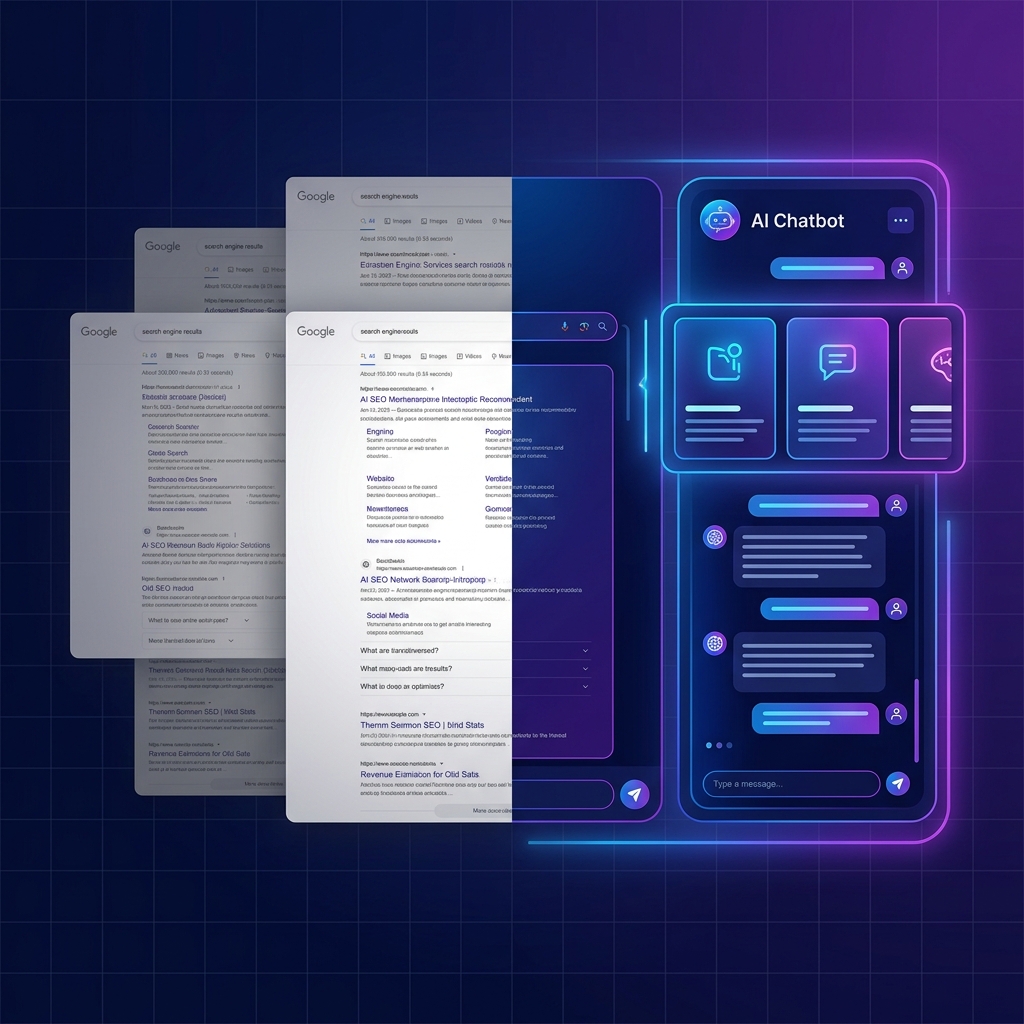
But it gets worse. More and more people aren't even using Google. They're opening ChatGPT, Gemini, or Perplexity and asking directly: "Who's the best plumber in Denver?" And those platforms don't show 10 results. They give ONE recommendation.
The question to ask your agency: "What percentage of searches in my industry result in actual clicks to organic results? And what's my ChatGPT visibility?"
If they can't answer both questions, they're selling you a 2019 strategy at 2026 prices.
Lie #2: "Your Rankings Are Improving" (But Your Revenue Isn't)
Not necessarily.
Here's what those reports often hide:
The keywords they're ranking you for have zero commercial value. Some agencies cherry-pick low-competition, low-volume keywords to show "improvement." You're now #1 for "residential copper pipe installation techniques" — a keyword nobody with buying intent is actually searching for.
Rankings don't equal revenue. You can rank #1 for a dozen terms and still see zero increase in leads or sales. Rankings are an input metric, not an output metric. The only numbers that matter are leads, calls, form submissions, and revenue.
They're not tracking AI visibility at all. While your Google rankings inch up, 200+ million people per week are asking ChatGPT for business recommendations — and your business isn't being mentioned. That's an entire lead channel your agency doesn't even measure.
The test: Look at your revenue from the last 6 months. Has it increased proportionally to what your agency claims about your rankings? If your rankings are "improving" but your phone isn't ringing more, you're being sold activity, not results.
What actually matters in 2026: • Leads generated (calls, form fills, bookings) • Cost per lead • AI visibility (are you being recommended by ChatGPT, Gemini, Perplexity?) • Revenue directly attributable to organic channels
Lie #3: "Backlinks Are the Most Important Factor"
Yes, backlinks still matter for Google rankings. But here's what your agency probably isn't telling you:
1. Google has dramatically devalued low-quality backlinks. The algorithm updates of 2024-2025 specifically targeted link schemes, PBNs (Private Blog Networks), and purchased links. If your agency is building links through blog comment spam, directory submissions to irrelevant sites, or "guest post" services that publish on link farms, those links are either worthless or actively harmful.
2. AI doesn't care about your backlinks AT ALL. When ChatGPT decides which business to recommend, it's not checking your Ahrefs domain rating. It's evaluating your content authority, trust signals, review quality, and cross-platform consistency. A business with 50 high-quality backlinks and thin website content will lose to a business with 10 backlinks but comprehensive, authoritative content — every time, on AI platforms.
3. The effort spent on backlinks could be better invested. The hours and money your agency spends building backlinks could be redirected toward creating authority content, amplifying trust signals, and optimizing your AI visibility — activities that impact BOTH Google and AI platforms.
The industry's dirty secret: Many agencies focus on backlinks because it's the easiest thing to outsource cheaply. They buy links from overseas providers at $5-50 each and charge you $200-500 per link. The margins are enormous, and the results are minimal.
Ask your agency: "Can you show me the specific revenue impact of each backlink you've built in the last 6 months?" Watch the silence.
Lie #4: "We Have a Proprietary Strategy" (Translation: We Won't Tell You What We Do)
Here's the truth: there are no secrets in SEO or GEO. The strategies are well-documented, the best practices are publicly available, and the platforms themselves publish guidelines for what they want.
When an agency says their strategy is "proprietary," it usually means one of three things:
1. They're doing so little that transparency would embarrass them. Some agencies charge $3,000/month and spend 2-3 hours on your account. The rest is a nice report generated by automated tools. If you knew how little actual work was being done, you'd cancel immediately.
2. They're using black-hat tactics they don't want you to know about. Link buying, content spinning, cloaking, and keyword stuffing are all "proprietary strategies" that could get your website penalized or delisted by Google. If they won't show you the work, there's a reason.
3. They genuinely don't understand what they're doing. Some agencies stumbled into a process that worked once and now apply it to every client regardless of industry, competition, or business goals. They can't explain it because they don't actually understand it.
What a legitimate agency looks like: • They explain their strategy clearly and in terms you can understand • They give you access to all your data and accounts • They set clear KPIs tied to business outcomes (not vanity metrics) • They provide detailed reports showing exactly what work was done • They proactively educate you about changes in the search landscape
The litmus test: Ask your agency to walk you through, step by step, what they did on your account last month. If they can't give you a clear, detailed answer, you have a problem.
Lie #5: "AI Search Is Just a Fad — Google Isn't Going Anywhere"
Yes, Google isn't disappearing. It still processes billions of searches daily. But the WAY people use Google has fundamentally changed — and your SEO agency's refusal to acknowledge this is costing you customers every single day.
The facts they're ignoring:
• ChatGPT has 200+ million weekly active users asking it to recommend businesses, products, and services. This number is growing 30%+ year over year. • Google's own AI Overviews now appear in 30%+ of search results, synthesizing answers and reducing click-through to organic results • Perplexity is growing at 40% month-over-month, specifically targeting search use cases • 65%+ of Google searches end in zero clicks — users get their answer without visiting any website • Voice search (powered by AI) is becoming the default on smartphones, smart speakers, and cars
When your agency says "Google isn't going anywhere," they're technically correct but strategically wrong. Google IS changing. It's becoming an AI platform itself. And the strategies that worked for Google's old algorithm don't work for its new AI-powered features.
The analogy: Imagine telling a business in 2005, "Phone books aren't going anywhere, you don't need a website." The phone books didn't disappear overnight — but the businesses that failed to adapt became invisible to a generation of customers who moved to a new discovery channel.
That's exactly what's happening now with AI search. Your agency doesn't want to learn new skills, so they're telling you the earthquake isn't happening. Meanwhile, your competitors are already building for the new landscape.
Lie #6: "We're Also Handling Your AI Visibility"
Here's a simple test: Ask your agency these questions:
1. "What does ChatGPT currently say about my business when someone asks for the best [your service] in [your city]?" If they don't know, they're not monitoring your AI visibility.
2. "Which competitors does ChatGPT recommend instead of us?" If they can't name them, they haven't done basic competitive analysis on AI platforms.
3. "What specific actions have you taken in the last 30 days to improve our AI visibility?" If the answer is vague or just refers to their regular SEO activities, they're not doing GEO.
4. "Can you show me our AI recommendation tracking data?" If they don't have any, AI visibility isn't part of their process.
5. "How does our schema markup support AI comprehension of our business?" If they can't explain this specifically, they don't understand the technical requirements of GEO.
The truth: Optimizing for AI requires genuinely different skills, tools, and strategies than traditional SEO. It requires understanding how large language models process information, what content structures AI prefers to cite, and how to build entity-level authority across multiple AI platforms. A traditional SEO agency claiming they "also do AI" is like a newspaper ad salesman claiming they "also do social media marketing." The fundamental skills are different.
Our recommendation: Keep your SEO agency for Google rankings if they're delivering genuine results. But add a dedicated GEO specialist for AI visibility. These are complementary strategies — but they require specialized expertise.
Lie #7: "SEO Takes 6-12 Months — Just Be Patient"
Here's the nuance: SEO CAN take 6-12 months for highly competitive keywords in saturated markets. That part is true. But there are two problems with how agencies use this line:
1. It's used to justify zero accountability. A legitimate agency should be showing you measurable progress within 60-90 days — even if you haven't hit your ultimate ranking goals. Progress includes: indexing improvements, visibility gains for lower-competition terms, technical fixes that improve crawlability, content performance data, and foundational wins. If nothing has improved after 3 months, patience isn't the answer — a strategy change is.
2. AI visibility doesn't take 6-12 months. This is the game-changer. While Google SEO can be slow, AI search optimization typically shows measurable results within 30-60 days. Our average time to #1 ChatGPT recommendation is 43 days. If your agency is telling you to "be patient" for 12 months while your competitors are capturing AI visibility in 60 days, they're not serving your interests.
The bottom line: Of course quality work takes time. But "be patient" without milestones, without accountability, and without acknowledging new opportunities in AI search? That's not patience — that's a blank check.
What You Should Actually Be Investing In
1. AI Visibility (GEO) Get your business recommended by ChatGPT, Gemini, Perplexity, and other AI platforms. This is the fastest-growing customer acquisition channel, and the competition is still low. Businesses investing now are establishing dominant positions that will be extremely difficult to displace.
2. Authority Content (Not Just Blog Posts) Stop publishing 500-word blog posts for keyword purposes. Create comprehensive, genuinely helpful resources that demonstrate real expertise. One authoritative 3,000-word guide is worth more than twenty thin blog posts — for both Google and AI visibility.
3. Trust Signal Architecture Systematically build reviews across multiple platforms, create detailed case studies, secure media mentions, and ensure every trust signal is visible and structured for both human and AI consumption.
4. Cross-Platform Consistency Audit and optimize your presence across 40+ directories, review sites, and social platforms. AI cross-references multiple sources, so inconsistencies destroy your credibility with AI platforms.
5. Technical AI Optimization Implement comprehensive schema markup, ensure AI-readable content structure, and optimize your site architecture for both traditional crawlers and AI models.
The investment hierarchy for 2026: AI Visibility → Authority Content → Trust Signals → Technical SEO → Traditional Link Building
Most agencies have this completely inverted, prioritizing the bottom of the list while ignoring the top.
How to Audit Your Current Agency (The 10-Minute Test)
Question 1: "What does ChatGPT recommend when someone asks for the best [my service] in [my city]?" → If they don't know: RED FLAG
Question 2: "What's our click-through rate from organic search compared to 12 months ago?" → If it's declining and they haven't addressed why: RED FLAG
Question 3: "What specific AI search optimization work are you doing for us?" → If the answer is "our SEO work covers that": RED FLAG
Question 4: "Can you show me the exact work done on my account last month with time logs?" → If they refuse or can't provide specifics: RED FLAG
Question 5: "What new strategies have you implemented in response to AI search growth?" → If none: RED FLAG
Scoring: • 0 red flags: You may have a great agency — but still consider adding AI visibility • 1-2 red flags: Have a serious conversation about strategy evolution • 3+ red flags: Start looking for alternatives immediately
The digital marketing landscape has fundamentally changed. The agencies that haven't evolved with it aren't just underperforming — they're actively costing you opportunities.
Want to know what AI actually thinks about your business right now? Book a free AI Visibility Audit with us. We'll show you exactly where you stand in AI search, who your competitors are in this new landscape, and what it takes to become the business that AI recommends.
No pressure, no obligation — just the truth your current agency might not be telling you.
Want These Results for Your Business?
Book a free strategy session and let our team show you exactly how we'll get your business recommended by ChatGPT within 60 days.
Book a Free Call