The $150 Billion Question Nobody's Asking
A homeowner's AC breaks down at 2 AM in Phoenix. Five years ago, they'd Google "emergency HVAC repair near me" and click one of the top results. Today? They open ChatGPT and type: "What's the best emergency AC repair company in Phoenix?"
ChatGPT doesn't show them 10 blue links. It gives them ONE recommendation. Maybe two. And if your business isn't the one being recommended, you don't just lose a ranking , you lose the entire customer.
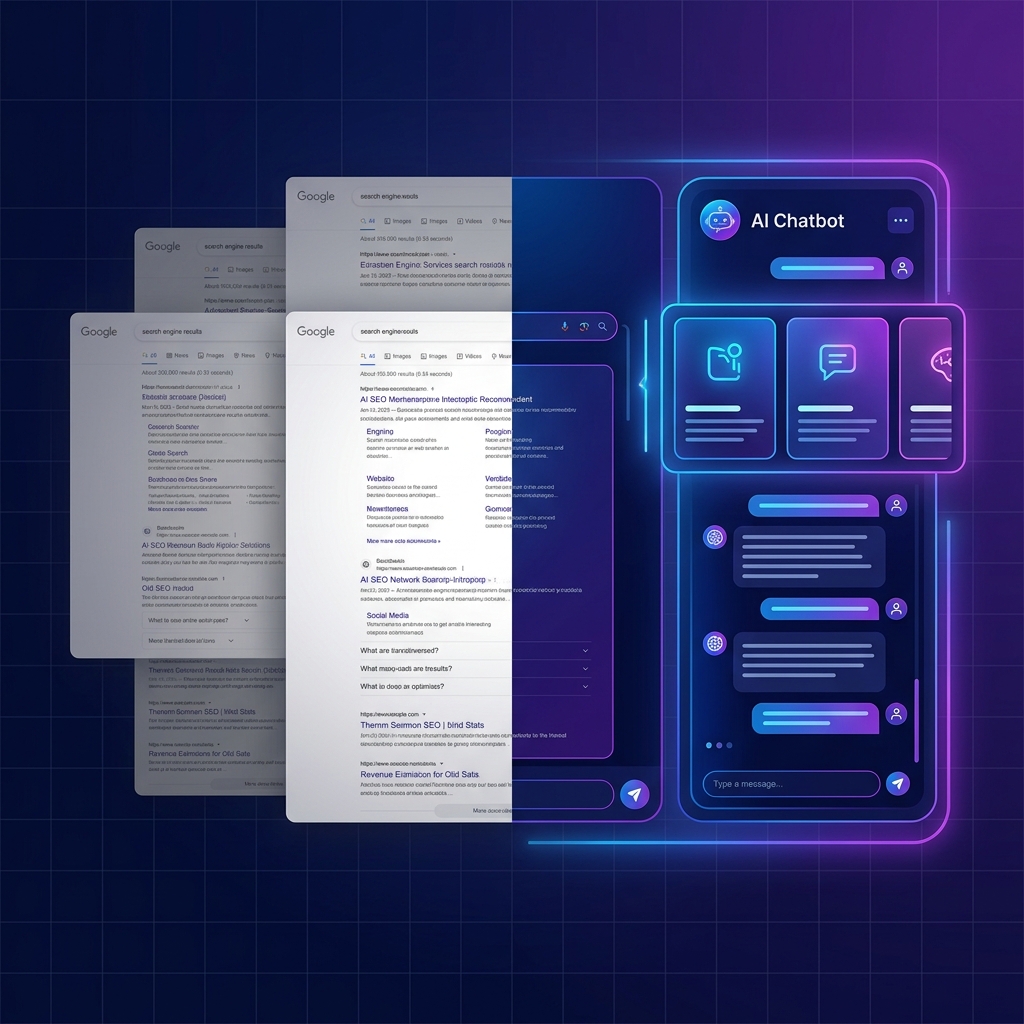
This is the fundamental shift that most business owners and even most marketing agencies haven't fully grasped yet. The era of competing for page-one rankings is giving way to competing for AI recommendations. And the strategies required are fundamentally different.
That's the difference between SEO and GEO. And understanding it isn't optional anymore , it's survival.
What Is GEO (Generative Engine Optimization)?
SEO (Search Engine Optimization) is the practice of optimizing your website and online presence to rank higher in traditional search engine results , primarily Google. It's been the backbone of digital marketing for two decades.
GEO (Generative Engine Optimization) is the practice of optimizing your business's entire digital footprint so that AI-powered platforms , ChatGPT, Google Gemini, Perplexity, Microsoft Copilot, Claude , recommend your business when users ask for suggestions.
Here's the critical distinction:
• SEO gets you ranked on a list. The user still chooses from 10 options. • GEO gets you recommended as THE answer. The AI does the choosing for the user.
Think of it this way: SEO is like getting your business listed in the Yellow Pages. GEO is like having a trusted friend personally recommend your business to everyone who asks.
Which one do you think converts better?
SEO vs GEO: The Full Comparison
🎯 Goal • SEO: Rank on page 1 of Google search results • GEO: Be the business that AI recommends by name
📊 Success Metrics • SEO: Keyword rankings, organic traffic, click-through rate • GEO: AI mention frequency, citation rate, recommendation positioning
🔧 Core Tactics • SEO: Keyword optimization, backlinks, meta tags, page speed • GEO: Authority content, trust signal amplification, entity optimization, structured data for AI comprehension
💰 Lead Quality • SEO: User clicks one of many results , comparison shopping is built in • GEO: AI pre-qualifies and recommends you specifically , leads arrive with trust already established
⏱️ User Behavior • SEO: "Let me search, compare, read reviews, and decide" • GEO: "ChatGPT says this is the best one , I'll call them"
🌍 Platforms • SEO: Google, Bing • GEO: ChatGPT, Gemini, Perplexity, Copilot, Claude, Grok, and every AI assistant coming next
The biggest shift? In traditional SEO, you're fighting for attention among 10 competitors on a results page. In GEO, you're fighting to be the ONE business that AI recommends. Winner takes all.
Why Traditional SEO Alone Is No Longer Enough
1. The Rise of Zero-Click Searches Over 65% of Google searches now result in zero clicks , the user gets their answer directly from the search page. Google's own AI Overviews now synthesize answers at the top of results, often citing sources but not requiring users to visit them. If you're only optimizing for clicks, you're optimizing for a shrinking pool.
2. AI Search Usage Is Exploding ChatGPT has over 200 million weekly active users. Perplexity is growing at 40% month-over-month. Google Gemini is integrated into Android and Google Workspace. These aren't niche tools anymore , they're becoming the default way people find businesses, especially for high-intent local queries.
3. AI Recommendations Carry More Trust When Google shows you 10 results, you know it's an algorithm. When ChatGPT says "the best plumber in Denver is XYZ Plumbing , they have 15 years of experience and specialize in emergency repairs," that feels like a personal recommendation. Studies show AI recommendations convert at 2-3x the rate of traditional search clicks.
4. Your Competitors Are Already Moving The businesses that invest in GEO now are establishing AI authority that will be extremely difficult to displace later. Just like the early days of SEO, first movers have a massive advantage. Every month you wait, a competitor is building the digital footprint that AI uses to recommend them instead of you.
5. AI Models Have Different Criteria Google's algorithm cares about backlinks, page speed, mobile optimization, and hundreds of technical factors. AI models care about authority, trust signals, content depth, entity clarity, and cross-platform consistency. A business can rank #1 on Google and still be invisible to ChatGPT , and vice versa.
How AI Decides Who to Recommend (And It's Not What You Think)
The AI doesn't just search Google and repackage results. It synthesizes information from its entire training corpus plus real-time web browsing to form an opinion. It's looking for:
1. Content Authority Does this business have comprehensive, expert-level content that demonstrates deep knowledge? Not thin blog posts with keywords stuffed in , genuine, helpful, authoritative content that proves expertise.
2. Cross-Platform Consistency Does this business appear consistently across directories, review platforms, social media, and industry publications? AI cross-references multiple sources to verify claims.
3. Trust & Social Proof Are there verified reviews, testimonials, case studies, and third-party endorsements? AI weighs social proof heavily because it needs high confidence before making a recommendation.
4. Entity Clarity Can AI clearly understand WHAT this business does, WHERE it operates, WHO it serves, and WHY it's the best option? This requires structured, unambiguous information across all digital touchpoints.
5. Recency Is the information current? AI deprioritizes businesses with outdated content, defunct social media accounts, or stale directory listings.
The key insight: AI doesn't rank pages , it forms opinions about businesses. And those opinions are based on the TOTALITY of your online presence, not just your website.
Real Results: What Happens When Businesses Invest in GEO
Plumbing Company (Madison, WI) Before: Invisible to ChatGPT despite 10+ years in business After: #1 recommended plumber in Madison in 38 days Result: 87% increase in organic traffic, 12 new qualified leads per month
Restaurant (Austin, TX) Before: Not mentioned in any AI dining recommendations After: ChatGPT's #1 restaurant recommendation in Austin Result: 52% increase in reservations, $31K additional monthly revenue
HVAC Company (Phoenix, AZ) Before: Losing emergency calls to competitors recommended by AI After: #1 AI-recommended HVAC company in Phoenix in 39 days Result: 82% increase in service calls, $24K additional monthly revenue
Pet Insurance Company (Boise, ID) Before: Overshadowed by big-budget national competitors in AI results After: ChatGPT's #1 recommended pet insurance provider Result: 128% increase in quote requests, 6.4% conversion rate from AI traffic
The pattern is clear: businesses that invest in GEO see dramatic results within 30-60 days. And the leads they generate from AI recommendations convert at significantly higher rates because the AI has already pre-qualified and endorsed them.
The GEO Framework: 5 Pillars of AI Visibility
Pillar 1: Authority Content Ecosystem Create comprehensive, expert-level content that covers every aspect of your business, industry, and service area. This isn't about blogging for blogging's sake , it's about building such a deep body of authoritative content that AI systems cannot ignore your expertise.
Pillar 2: AI-Readable Structuring Structure every piece of content for AI comprehension. This means proper schema markup, clear entity definitions, semantic HTML, and content formatted in ways that AI can easily extract and cite. Think of it as making your content "AI-friendly."
Pillar 3: Trust Signal Amplification Systematically build and amplify trust signals across every platform , reviews, testimonials, case studies, certifications, media mentions, industry partnerships. AI needs high confidence before recommending a business, and trust signals provide that confidence.
Pillar 4: Cross-Platform Dominance Ensure your business appears consistently and authoritatively across 40+ directories, review platforms, social media channels, and industry publications. AI cross-references multiple sources, so your presence needs to be everywhere.
Pillar 5: Continuous Monitoring & Optimization Regularly test how AI platforms respond to queries about your industry and location. Track competitor recommendations. Update content to stay fresh. AI visibility is not a one-time project , it's an ongoing strategy.
"But My SEO Agency Already Handles This" , No, They Don't
Traditional SEO agencies optimize for Google's algorithm. They focus on keywords, backlinks, page speed, Core Web Vitals, and meta tags. These are important for Google rankings, but they're largely irrelevant to how AI models form recommendations.
GEO requires a completely different skill set:
• Understanding how large language models process and synthesize information • Knowing what content structures AI prefers to cite • Building entity-level authority (not just page-level rankings) • Creating content depth that satisfies AI's need for comprehensive, authoritative sources • Optimizing across AI platforms (ChatGPT, Gemini, Perplexity, Claude) , each with different behaviors
A simple test: Ask your SEO agency what your business's current ChatGPT visibility looks like. Ask them which competitors ChatGPT recommends instead of you. If they don't have answers , or worse, if they've never even checked , that tells you everything you need to know.
The best approach? Keep your SEO agency for Google rankings AND add a GEO specialist for AI visibility. These are complementary strategies, not competing ones.
The Cost of Waiting
AI authority compounds. The longer a business has been building authoritative content, trust signals, and cross-platform consistency, the more confidently AI recommends them. And the more confidently AI recommends them, the harder it becomes for competitors to displace them.
We're in a land-grab moment right now. Most businesses haven't even heard of GEO. Most marketing agencies don't offer it. The businesses that establish AI visibility NOW will have a structural advantage that lasts for years.
Consider this: in the early 2000s, businesses that invested in SEO early dominated Google rankings for a decade. The ones that waited had to spend 10x more to catch up. The same dynamic is playing out with GEO right now. But the window is closing faster because AI adoption is happening at a much faster rate than search engine adoption did.
Every month you wait: • Competitors build deeper AI authority • More customers switch to AI for business recommendations • The cost to achieve #1 AI recommendation increases • You lose leads to businesses AI trusts more than yours
How to Get Started with GEO Today
Option 1: DIY Assessment Right now, open ChatGPT and ask: "What's the best [your industry] in [your city]?" See what comes up. Then ask about your specific business by name. Is ChatGPT aware of you? Does it recommend you? If not, you know you have a problem.
Option 2: Free AI Visibility Audit We offer a complimentary AI visibility audit where we: • Check your current ChatGPT, Gemini, and Perplexity visibility • Identify which competitors are being recommended instead of you • Analyze the gaps in your digital footprint that are keeping you invisible to AI • Provide a roadmap for achieving #1 AI recommendation in your market
Option 3: Full GEO Implementation Work with us directly. We handle everything , content strategy, trust signal amplification, AI-readable structuring, cross-platform optimization, and ongoing monitoring. Our average time to #1 ChatGPT recommendation is 43 days, and we offer a money-back guarantee.
The businesses winning in 2026 aren't just optimizing for Google , they're optimizing for the AI platforms that are increasingly becoming the first place people go for recommendations.
SEO gets you found. GEO gets you chosen. Which one matters more to your business?
Want These Results for Your Business?
Book a free strategy session and let our team show you exactly how we'll get your business recommended by ChatGPT within 60 days.
Book a Free Call