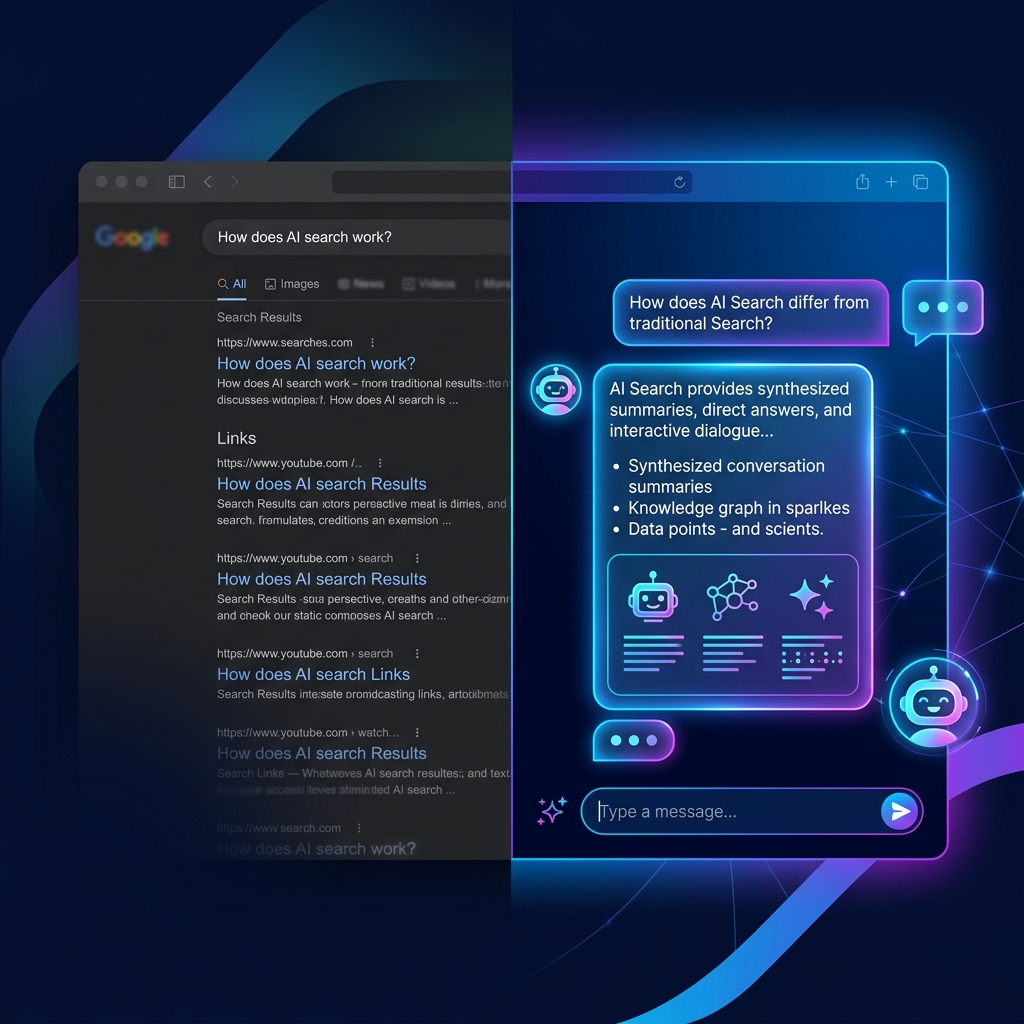
Two Searches, Two Completely Different Experiences
Google Search: Type "best dentist in Portland" into Google. You get a map pack with 3 listings, followed by 10 organic results, sprinkled with ads. You need to click into multiple websites, compare reviews across platforms, and make your own decision. The whole process takes 15-30 minutes.
AI Search: Type the same question into ChatGPT. You get a direct recommendation: "One of the most highly recommended dental practices in Portland is Wells Dental, known for their patient-first approach, gentle care, and comprehensive services including sedation dentistry for anxious patients." Decision made in 30 seconds.
This is the fundamental shift happening in 2026. Consumers are moving from a model where they do the work of comparing and choosing, to a model where AI does the work FOR them.
And the implications for your business are enormous.
How Google Search Actually Works (A Quick Refresher)
1. Crawling: Google's bots continuously scan the internet, discovering and reading web pages.
2. Indexing: Pages are organized in Google's massive index based on their content, structure, and relevance signals.
3. Ranking: When you search, Google's algorithm evaluates hundreds of factors to determine which pages are most relevant: keywords, backlinks, page authority, user experience signals, page speed, mobile optimization, and more.
4. Display: Google shows you a ranked list of results, and you choose which one to click.
Key characteristics of Google Search: • Shows multiple results and lets the user choose • Rankings are determined by algorithmic signals • Paid ads can appear above organic results • Results are page-level (individual web pages are ranked) • Users need to click through to get detailed information • The experience is transactional: query in, links out
How AI Search Actually Works (The New Model)
1. Understanding: Instead of matching keywords, AI understands the full meaning and context of your question. "What's the best dentist for someone afraid of the dentist?" is understood as a query about dental anxiety, sedation options, gentle approach, and patient comfort.
2. Research: AI scans its training data and, when browsing-enabled, the live internet to gather information about relevant businesses. It doesn't just check websites, it synthesizes information from directories, reviews, news, social media, and more.
3. Evaluation: AI evaluates businesses holistically, weighing expertise, trust signals, review quality, content authority, and cross-platform consistency. It forms an OPINION rather than running an algorithm.
4. Recommendation: Instead of showing 10 links, AI provides a specific, reasoned recommendation. "Based on reviews, expertise, and patient feedback, I recommend X because..."
Key characteristics of AI Search: • Gives a specific recommendation (not a list of options) • Evaluates businesses holistically across the entire internet • Cannot be influenced by paid advertising • Recommendations are business-level (not page-level) • Users get their answer without clicking through to websites • The experience is conversational and trust-based
The 7 Critical Differences That Affect Your Business
1. One Winner vs. Ten Winners Google shows 10 results on page one. If you're anywhere in the top 10, you get some traffic. AI typically recommends 1-3 businesses. If you're not the recommendation, you get nothing. The stakes are higher, but the reward for winning is absolute.
2. Earned Trust vs. Algorithmic Ranking Google ranks pages based on technical signals (backlinks, page speed, keywords). AI recommends businesses based on perceived trustworthiness and authority across the entire internet. You can game Google's algorithm. You can't game AI's judgment.
3. Pre-Qualified Leads vs. Comparison Shoppers Google sends you visitors who are still in research mode, comparing you against every other result. AI sends you visitors who've already been told you're the best. These leads convert at 2-3x higher rates.
4. Zero-Click vs. Click-Through Over 65% of Google searches result in zero clicks (thanks to featured snippets and AI Overviews). In AI search, zero-click is the DEFAULT, users get their answer without ever visiting your website. Your visibility in the AI response IS the marketing.
5. Whole Business vs. Single Page Google evaluates individual pages. AI evaluates your ENTIRE business across every online touchpoint. A strong homepage means nothing if your directory listings are inconsistent and your reviews are sparse.
6. Permanent Value vs. Pay-to-Play Google Ads stop generating leads the moment you stop paying. AI recommendations persist as long as your authority holds. GEO is an investment that compounds, not an expense that depletes.
7. Growing vs. Plateauing Google search traffic has plateaued as users shift to AI. AI search usage is growing exponentially. Optimizing for Google is maintaining your current position. Optimizing for AI is positioning for the future.
What This Means for Different Types of Businesses
Local Service Businesses (Plumbers, HVAC, Electricians) IMPACT: CRITICAL. These are high-urgency, trust-dependent queries where AI gives a single recommendation. Being #1 in AI search can mean the difference between getting the call and never knowing the customer existed.
Restaurants and Hospitality IMPACT: HIGH. "Where should I eat?" is one of the most common AI queries. Tourists especially rely on AI recommendations. One recommendation can drive 30+ new customers per week.
Professional Services (Lawyers, Accountants, Consultants) IMPACT: HIGH. High-value services where trust is paramount. A single AI recommendation can be worth tens of thousands in revenue.
Healthcare Providers IMPACT: HIGH. Patients increasingly ask AI for doctor recommendations. AI treats healthcare queries with extra scrutiny, so only providers with overwhelming evidence of quality get recommended.
E-commerce and Online Retail IMPACT: MODERATE. AI is increasingly used for product comparisons and recommendations, but the dynamics are different from local business search. Product-specific AI optimization is an emerging field.
B2B Companies IMPACT: GROWING. As business buyers adopt AI for vendor research, B2B companies with strong AI presence will have a distinct advantage in lead generation.
The Numbers That Tell the Story
AI Search Adoption • ChatGPT: 200M+ weekly active users (and growing) • Google Gemini: Integrated into 2B+ Android devices • Perplexity: 100M+ monthly visits, growing 40%+ month-over-month • Microsoft Copilot: Built into Windows 11 and Office 365
Google Search Behavior Changes • 65%+ of Google searches end in zero clicks • Google AI Overviews now appear in 30%+ of search results • Mobile voice searches (increasingly AI-powered) up 35% year-over-year
Business Impact Data (From Our Clients) • Average time to #1 AI recommendation: 43 days • Average lead increase after AI optimization: 70%+ • AI-referred lead conversion rate: 2-3x higher than Google organic • Average additional monthly revenue: $14K-$31K • Average campaign ROI: 850%+
The trajectory is clear: AI search isn't replacing Google overnight, but it IS capturing a rapidly growing share of high-intent business discovery queries. And the businesses positioned for both channels are the ones winning.
The Smart Strategy: Optimize for Both
What helps BOTH Google and AI: • High-quality, comprehensive content • Positive reviews across multiple platforms • Consistent business information across directories • Schema markup and structured data • Mobile-friendly, fast-loading website • Regular content updates
What helps Google specifically: • Keyword optimization • Backlink building • Technical SEO (Core Web Vitals, page speed) • Google Business Profile optimization • Local SEO signals
What helps AI specifically: • Entity-level authority (not just page-level) • Content depth that demonstrates genuine expertise • Cross-platform trust signal amplification • AI-readable content structuring • Multi-platform consistency check
The ideal approach: maintain your existing SEO efforts AND add a GEO layer on top. This ensures you're visible wherever potential customers are searching, whether that's Google, ChatGPT, Gemini, or the next platform we haven't seen yet.
What Happens If You Ignore AI Search
Short-term (next 6 months): You'll gradually lose some customers to competitors who are being recommended by AI. The impact might feel small at first, maybe a few missed calls or fewer walk-ins than usual.
Medium-term (6-18 months): As AI adoption continues accelerating, the trickle of lost customers becomes a stream. Competitors who invested early in GEO will have established strong AI authority, making it increasingly expensive and difficult for you to catch up.
Long-term (18+ months): AI becomes a primary channel for business discovery. Businesses without AI visibility will be like businesses without websites in 2010, technically still operating, but missing a massive and growing channel of customer acquisition.
The cost of waiting isn't just the customers you lose today. It's the compounding advantage your competitors build while you wait.
Your Next Step
Start by understanding where you stand today:
1. Test your AI visibility: Ask ChatGPT, Gemini, and Perplexity about your industry in your city 2. Document the gap: Note who's being recommended instead of you 3. Assess your digital footprint: Is your online presence comprehensive and consistent enough for AI to confidently recommend you?
Or skip the DIY approach and get a professional assessment. We offer a free AI Visibility Audit that gives you a complete picture of your current AI search presence, your competitors' positions, and a clear roadmap to becoming the business AI recommends.
The businesses winning in 2026 aren't choosing between Google and AI. They're dominating both. And it starts with one step.
Book your free audit and let's make sure your business is visible wherever your customers are searching.
Want These Results for Your Business?
Book a free strategy session and let our team show you exactly how we'll get your business recommended by ChatGPT within 60 days.
Book a Free Call